Prerequisites: Have an amateur radio license with the proper privileges or be with someone who does.
Have a working HF radio setup or be with someone who does
You may have had a few contacts on the air, and maybe you enjoy being a bit competitive. Contesting is a fast-paced, highly competitive, and enjoyable facet of amateur radio.
Amateur radio contests are like a race on a racetrack, but everyone gets to race on the same track. Some enjoy comparing their score to previous years, some clubs have a friendly contest between members, and some want to win division and class awards.
You need to have an HF radio setup or be with someone who does. I highly recommend that you find a local operator so you can get hands-on experience. Most operators are happy to host new contesters. It also allows operators to swap out when they get tired – yes, you will get tired!
First: What is a contest? An amateur radio contest is an on-the-air contest to try to make as many points as possible. Each contest is different and uses different radio modes (digital, CW, SSB) and has different ways of scoring points. Some have multipliers, and some don’t. Some have extra rules; some don’t.
Before the Contest:
Just like a car going to the racetrack, you should have a plan for how you will operate. Some contests require a ‘rest period’ or limit band switching. You may also want to try a special class like QRP or Band Specific Class (Example 10M)
You should also check to make sure your radio, antenna, and logging software work correctly.
What Logging Program Should I use?
N1MM is very popular for contesters, but it has a steep learning curve
N3FJP logging suite is a great general-purpose logger that also includes contest software. It costs $60.
How do I know the dates of upcoming contests?
WA7BNM has a great website that shows all the contests – current and upcoming. Here is the website: https://www.contestcalendar.com/
What is the exchange? What is the Serial Number?
Every contest has an exchange – a piece of info that is needed. Check the contest rules for the exchange.
For example, ARRL Field Day has a few different classes for your station is. The station class is the number of radios on the air at a time, and the source of power. Then there is the ARRL section that you are in. OTVARC typically uses the exchange 4A OR. Oregon has its own section; more populous states have multiple sections.
CQ Worldwide contest uses signal report (59), and the CQ zone – Oregon is zone 3. Here is a map of the CQ zones: https://www.mapability.com/ei8ic/maps/cqzone.php
During the Contest
Contest Etiquette
Remember, this is a contest, and many operators want to ‘win’. If you would like to have a normal conversation/ragchew with another operator, change bands to the WARC bands – contesting is not allowed on these bands. WARC bands are pretty quiet during contest weekends.
If you are going to make contact with a station that is contesting, make sure that you have the exchange ready. Don’t waste the operator’s time by asking what the exchange is, or what contest it is. The contester is trying to get as many points as possible.
Do I need to submit a log to make contact with contesting stations?
No! Many operators enjoy making quick contacts to fill up their logbook with rare states or DX entities. Just be courteous and know the exchange BEFORE initiating contact with that station.
After the Contest:
What is a Cabrillo file? Is this a log file?
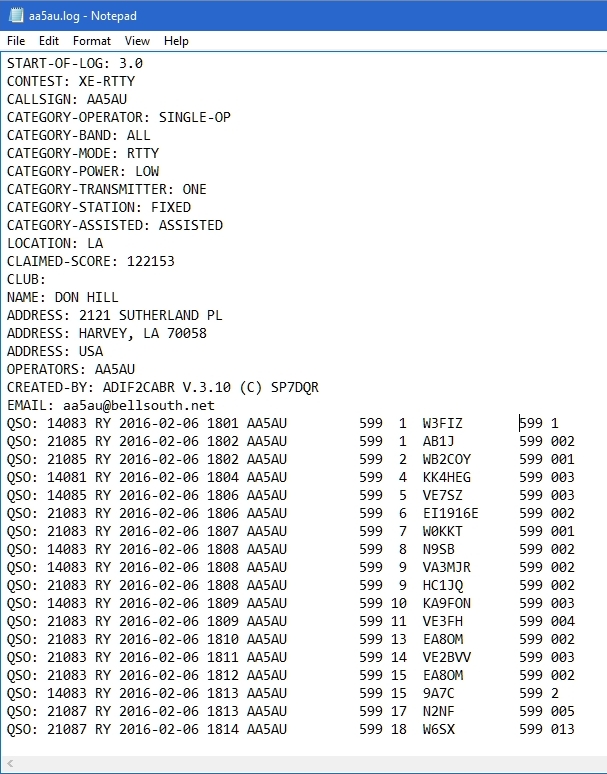
A Cabrillo file is not a standard log file. It is specific to contests. It includes information for the contest, such as operating category, power, claimed score, and mode.
Log files are saved with .adi or .adif extension. This is a standard for all ham radio loggers. All should be able to export and import logs in this format. Find more info on logs and logging here: LOGS LINK
Here is an example:
How Soon Should I submit My Score, Cabrillo, or log file?
You should submit as soon as you can. Most submission windows are very short. Each contest is different. Don’t be surprised by submission dates! Most contests only accept the Cabrillo format – Not ADIF.
Don’t forget to export the ADIF file, then import it into your normal logger to get confirmations for the contacts you made during the contest.
How Can I Check My Score? What do I get if I win?
Try visiting the sponsor of the contest. If it is an ARRL contest, check this website: https://contests.arrl.org/scores.php
As for winning, some of the top performers in their classes get plaques. There are often certificates that you can print out. Just look at the results after a contest is finished.