
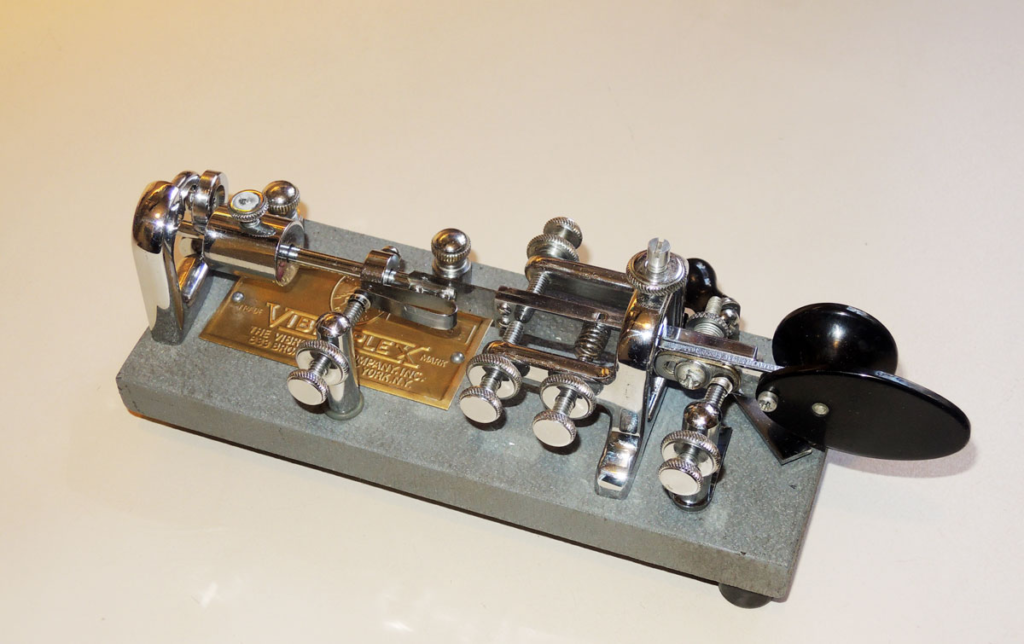
What is a bug?
A CW bug is a fantastic bit of practical history and usable radio equipment. It is called a semi-auto key. It auto-generates dots while the operator manually generates the dashes. They were developed in the early 1900s because of operator fatigue while using straight keys.
How does it work?
A bug or semi-auto key auto-generates the dits while the operator makes the dahs.
Notice the bug only requires 2 conductors: this is because the code is generated from the key and not by an external keyer. Plug the bug into the straight key port or set the radio to straight key – do not use the paddle port or paddle setting.
How do you set the speed?
The speed of a bug is controlled by 2 parts: the movable weight on the arm generating dits and the operator generating dahs. If you want to go faster, move the weight closer to you. For slower, move the weight away from you.
How is this different from an iambic paddle?
An iambic paddle on its own can not generate the dits and dahs – it needs a keyer circuit for that. A bug is different because it generates the code with manual springs and mechanisms – no keyer circuit needed. Iambic paddles were meant as a direct stand-in for straight keys, as paddles had not been invented yet.
Should I Use a Bug?
Sure! If you have an interest, you should try it. I have personally tried them, and I was not able to master them. Some operators can use them, but not me. I went back to my straight key. Don’t let my experience affect yours.
Be warned, this type of instrument takes much practice to get right. If the other operators can’t understand what you’re sending, you won’t be able to complete the contact. I have personally heard bugs on the air that were impossible to understand.
What is a left-handed bug?
A left-handed bug is the same as a regular bug, except that the action is backwards. The shorts are made by pushing the right side, and the longs by pressing the left side.
Here is a demonstration of the use of a bug