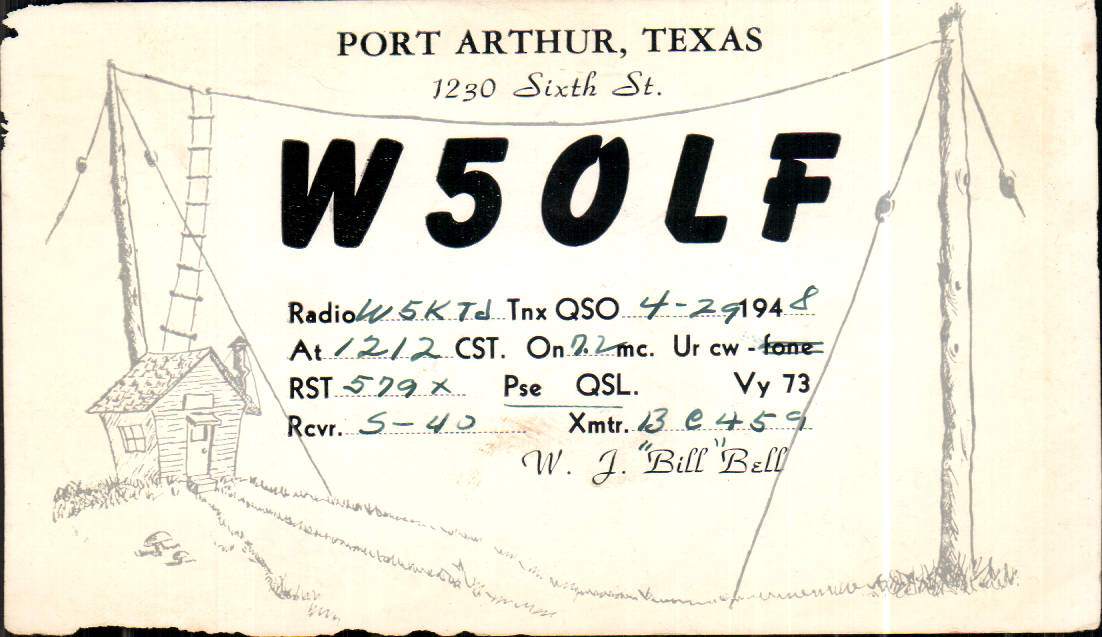
You had a few contacts on the air, fantastic! Maybe you got a piece of unexpected mail. It is about the size of a postcard.
What is a QSL Card?
Put simply, a QSL card is a confirmation of a contact. Before the days of electronic logbooks and internet confirmations, the only way to prove (confirm) you had a contact was to receive a QSL card. And many radio awards would only accept QSL cards as proof for the award.
Why Exchange QSL Cards?
QSL cards are still valid confirmations today – even in the internet era. For example, the ARRL and the JARL (Japanese Radio League) will accept QSL cards for their awards. The ARRL even has card checkers to give you credit towards awards, such as Worked All States or DXCC.
There are many hams that use QSL cards to showcase their interests and backgrounds.
What is on a QSL card?
Every valid QSL card should have these pieces of info:
Callsign of the station
Callsign of the worked station
Band or Frequency
Date + Time (UTC is the standard)
Mode (CW, SSB, AM, FM, Digital, etc)
RST (Signal report in the format of 599 for CW and 59 for voice). See HOW TO HAVE A QSO for details.
Please or Thanks QSL – This says if you would like a QSL or if you are responding to theirs
What is SASE or SAE?
SASE is a Self-Addressed Stamped Envelope – It is courteous to make it easier for the other operator to respond to your QSL request. The other operator simply needs to fill out their own card, place it inside the envelope, and put the envelope in a mailbox.
Is there a size of envelope that works best?
Personally, I have found that getting 2 sizes of envelopes makes the process easier. Use a #7 and a 6-3/4 envelope. The 6-3/4 fits well inside the #7. You can also use an A-6 and an A-2. Both of these sizes will fit all standard QSL sizes.
What size should my QSL be?
According to the ARRL, the range can be from 4-3/4 inches to 6-1/4 inches wide and from 2-3/4 inches to 4-1/4 inches. Region 2 has suggested the following dimensions as optimum for QSL bureau sorting: 5-1/2 inches x 3-1/2 inches.
What is a ‘Green Stamp’?
Imagine this: You are a lonely ham radio operator in Obrastan – a very sparsely populated country in a lonely corner of the world. Lots of hams want to get your QSL card so they can prove that they contacted you on the radio. You receive 100 QSL cards with requests to send yours in return. 100 envelopes going outside the country cost $1.50 each. That is $150 in postage alone. To help with the financial burden, it is courteous to send a small amount of money to cover postage. It is customary for US stations to send $2-$5 if they would like a QSL card in return. This helps these rare DX stations get their QSL cards to you without placing the financial burden on them. It is also a great idea to add a postage label with your callsign, so they don’t need to look up your info.
What if I don’t want QSL cards?
We understand you want to keep all of your QSLs and confirmations digital. The easiest way to tell other hams if you accept/don’t accept QSL cards is to list that on your QRZ.com profile.
I want to send QSL cards to DX stations, but it’s so expensive! Is there another way?
There is! There is the QSL Bureau! You can read more about it here: QSL BUREAU PAGE
In short, the QSL bureau saves money by sending cards in bulk to countries.