RTTY, also known as RadioTeleType, is one of the oldest forms of digital communications. The original teletype was developed in the mid-1800s but became practical from the 1920s until the end of WW2. It was used commercially to transmit messages long distances – think news. After the war, most commercial RTTY systems were retired along with the military systems. Amateur radio operators started using these machines on the air, and it became a popular mode. The machines may not be common anymore, but the mode was the dominant digital mode for decades. Today, you can still find RTTY on the air; there are still active contests that use it!
Audio sample of RTTY from Wikipedia
You will hear 2 tones, switching back and forth in frequency. Mark is the higher frequency, and the space is the lower frequency. The difference between the 2 frequencies is called the shift.
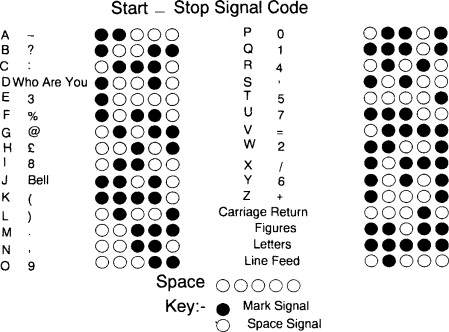
RTTY & 5-Bit Baudot Code
5 bits- 5 different combinations. 2^5 or 2x2x2x2x2 = 32. This is great because there are 26 letters of the alphabet. Except there are also numbers. Baudot was really clever and added a special character shift. With a ‘figures’ or ‘letters’ shift at the beginning of the transmission, this can be expanded to numbers, punctuation, and special characters/command characters.
How do I use RTTY?
The most common way to use RTTY is to use a computer that will encode and decode. Most modern radios will have a digital interface port you can connect to.
Common software for RTTY
FLDigi
MMTTY
FSK vs. AFSK
A more technical part of RTTY is the discussion of FSK – frequency shift keying, and AFSK – audio frequency shift keying.
AFSK is directing a soundcard inputEither will work, but you must know which your radio uses. Simply: AFSK can be easier to set up, but FSK can be more ‘traditional’ and reliable.
Where do I find RTTY?
RTTY can be found on all amateur HF bands. The more popular the band, the more likely you are to hear RTTY. Most RTTY can be found just above the CW portions. (14.080 is common)
Be aware! If you are a technician, you can only use RTTY on 10M. If you want to use RTTY on all the HF bands, you MUST have a general or extra class license!
How is RTTY different from FT8 and other Digital Modes?
RTTY is a very old digital mode. Because of its age, it lacks features that other modern digital modes have. It doesn’t have error correction, and the signal must be relatively strong to be decoded accurately. Despite this, RTTY is a popular contest mode.
PSK Olivia and other digital modes
These modes can also be found in the fldigi and other digital mode suites. These can appear the same while on a computer screen, but the technology and features are substantial vs. RTTY. For example, think of the advancements of cars since 1920 and 1990. RTTY was commercially used until the 1940s, when it was dropped in favor of more modern data transmission standards.
Think of RTTY like a classic car and PSK/Olivia as a newer car – PSK was developed in the 90s. Some features are the same, and some have been greatly improved.
FT8 is much different because it has error correction built into the message. This error correction allows for better weak signal decodes and resistance to interference. It is also not a ‘conversational’ mode, which means that the messages are rigid and are difficult to change. JS8CALL is built on the same technology as FT8, but allows for freeform (although VERY slow) conversational modes.
Want to see an original RTTY machine in action? https://www.youtube.com/watch?v=FWa6u5_Itvs
Ready to hear some on the air?
Use your own radio and antenna, and tune to 14.080.
Use an OpenWebRX server, tune to 14.080 LSB, set the receiver to digital and RTTY or RTTY skimmer.