What is the NATO Phonetic Alphabet?
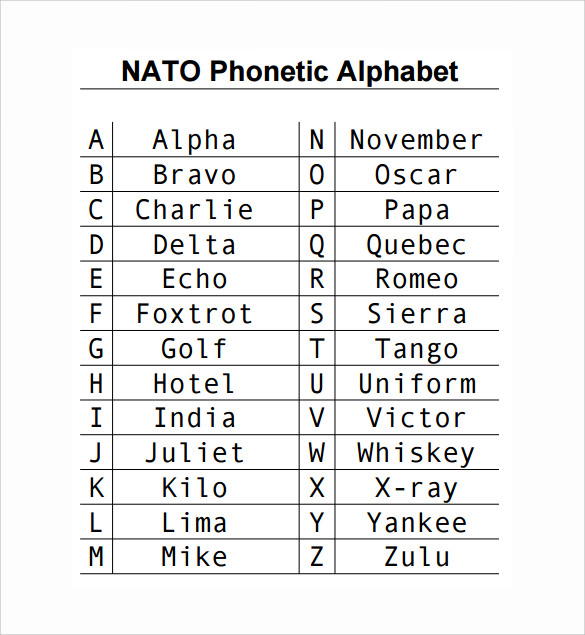
The NATO phonetic alphabet is a standard alphabet to make it easier to convey letters. It is standard for nearly every nation and is good practice to use – espicially on HF.
Here is the full phonetic alphabet:
Why use the Phonetics Alphabet?
I want you to imagine listening to someone say their callsign – just the letters.
N7LDB
Some letters sound like other letters. For example, B, D, E, G, and V all sound very similar. Adding some static and fading conditions would make it much harder to get the callsign correct.
Now imagine if you heard this instead:
November Seven Lima Delta Bravo
Now each of these letters has a distinct word attached to it. If you don’t hear the first part of the word, you can still decipher it. With each letter getting an entire word, it allows the receiver to copy the letters more slowly.
Is it illegal not to use this alphabet?
No, you are free to say whatever words you like. However, there are many operators that are expecting the standard alphabet, and using different words may make it more difficult to understand.
Using it helps with clarity and getting through a contact. You are more likely to complete a contact while using this.
Should I ONLY use the phonetic alphabet on the air?
Not necessarily. If you are on a repeater, the first time you say your callsign, you should use phonetics. After that, it is not necessary.
For HF, if you are having a long conversation with someone, the first time should be phonetic. After that, you can probably use regular letters.
Common Mistakes
Using Non-standard phonetics
For example: Kilowatt instead of kilo (kilowatt is neat, but some operators may confuse this with “KW” instead of just “K”
Speaking too fast. It is easy to rattle off your callsign quickly – you say it all the time! Just remember to slow down and let the receiver process the letters. Is it faster to say your callsign 2/3 times quickly or 1 time at a medium steady pace?
Mixing standard and non-standard phonetics. If you want to use fun phonetics, save it for the repeater or after you are mid-QSO.
It is also a good idea to add a minimal pause between letters.
Poor Microphone Settings and Etiquette
This means either not enough audio gain or too little mic gain. Either of these will distort your voice and make it difficult to hear you. Even if you are using the correct phonetics.
Also, if your microphone is too close or too far, this could affect your signal.